
All-in-One Agile· Remote (San Diego, CA)· Founded 2015
Parabol
Reuniões ágeis de código aberto para retrospectivas, poker, stand-ups e check-ins
Overall score
7.4
Reuniões ágeis de código aberto para retrospectivas, poker, stand-ups e check-ins
Best for: Distributed agile teams that want one open-source tool for retros, poker, standups and team health checks.
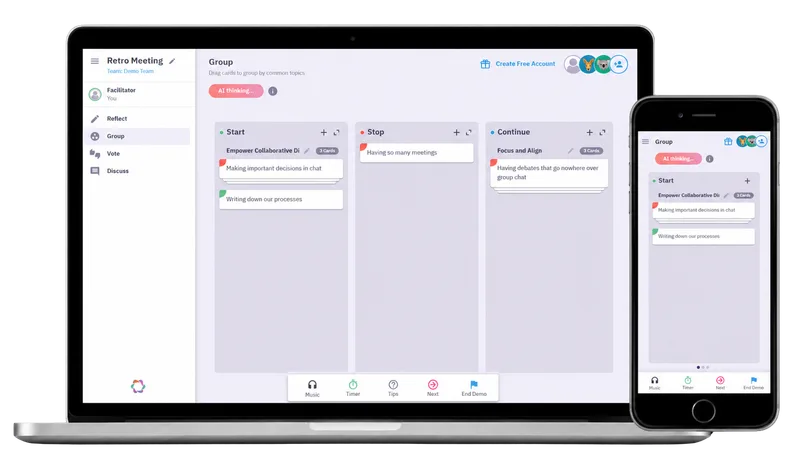
O Parabol se apresenta como a plataforma ágil de código aberto para reuniões — retrospectivas, sprint poker, stand-ups e check-ins em um único lugar, sob a licença AGPL-3.0 no GitHub, com uma opção local para empresas que não podem enviar dados de retrospectivas para a nuvem de terceiros.
“O Parabol dá estrutura às reuniões e transforma os resultados em conhecimento que toda a sua equipe pode pesquisar, compartilhar e usar como base.”
A página inicial agora destaca o conhecimento, não as formalidades: o Pages, o wiki integrado que publica automaticamente um resumo após cada reunião, é posicionado como o substituto do Confluence, e em 2026 foi adicionada uma função de exportação com um único clique para o Confluence Cloud. Uma linha separada voltada para o setor público oferece um contêiner Iron Bank reforçado até o nível IL5. A abordagem continua com um toque de engenharia — repositório público, um lançamento quase todas as semanas, um esquema GraphQL publicado, sem artifícios de vendas.
Parabol is still the most complete open-source retro stack you can buy, and it ships relentlessly — roughly forty releases since May. This pass, the interesting movement is at the two ends. On facilitation: automatic facilitator rotation, a Task Review phase on by default, Inspiration Items that pull Jira issues and prior standups into the reflect phase, and Zoom/Google Meet transcripts in the discussion drawer. On the platform side, the GraphQL API is now properly public — published SDL, a hosted GraphiQL, and scoped personal access tokens — which is more than most vendors here offer.
The bigger change is Team Health, rebuilt from the old emoji mood poll into a standalone recurring meeting with 10 built-in question packs — Project Aristotle, Edmondson, Lencioni, Hackman, Gallup Q12, Spotify, Atlassian, Project Oxygen, SCARF and a mixed set — plus custom questions. As of 21 Sep 2026 it is on production behind a feature flag for internal testing, with real teams due the following week, so ask where it is in the rollout before you buy on it. Know the shape: every pack is mapped onto the same 5 Aristotle categories, each cycle asks 5 Likert questions (one per category, rotating), results show a streak rather than a trend line, there is no cross-team rollup or export, and the packs are English only. Anonymous comments are paraphrased by an LLM at reveal and dropped if AI is switched off. It is on Team and Enterprise, not the free Starter plan, despite what the marketing page implies.
Elsewhere: still no whiteboard, presentation or screen-share mode, and "webhooks" remain Mattermost/MS Teams notification URLs. Confluence export is also flag-gated. Best fit: distributed teams living in Jira or Azure DevOps, and regulated orgs that need on-prem.
Last reviewed: 21 de setembro de 2026