
Retrospective Tools
Spreo logo
Retrospectives· UK· Founded 2019

Spreo

Playful collaborative whiteboard for agile teams

Overall score
5.9

Overview

Spreo (formerly Metro Retro, then Ludi — renamed Spreo on 1 July 2026 after a US trademark cease-and-desist) is a visual agile collaboration whiteboard with 100+ templates spanning retros, planning poker, icebreakers and futurespectives. Its illustrated canvas and board gadgets — a shared Jukebox music player, timers, spinners, buzzers, confetti, throwable hats — make ceremonies feel engaging. An official MCP server (beta) and a signed-in HTTP API landed during 2026, but Jira, SSO and PDF export all require the $6/user Business plan, and in-product AI stops at beta sticky-note clustering.

Best for: Agile teams who want retros, planning and workshops to feel visual and fun on a Jira backlog, and who would get real value from driving boards with an AI assistant over MCP — budget for the Business plan, which is where Jira, SSO and PDF export actually live.
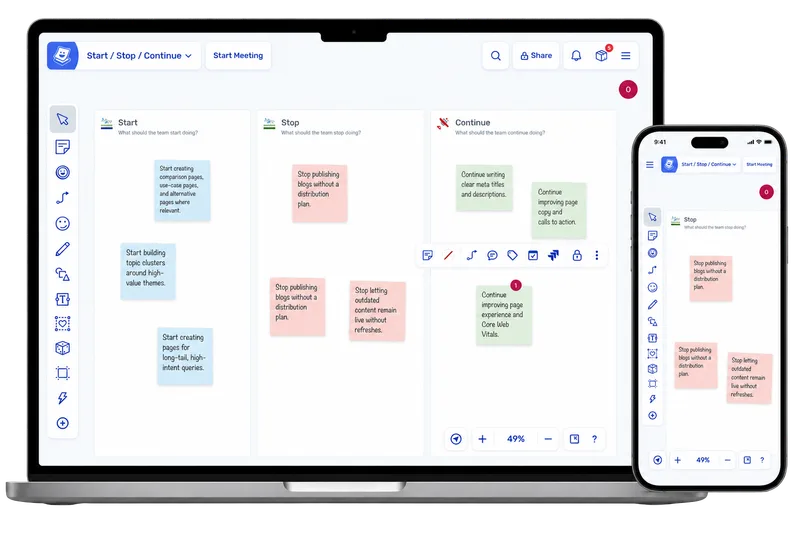
Spreo retrospective board shown on desktop and mobile

How Spreo describes itself

Spreo — Metro Retro until August 2025, then Ludi, and Spreo since 1 July 2026 after a US trademark holder's cease-and-desist — pitches itself as the whiteboard built for agile ceremonies rather than general brainstorming.

"Spreo is the online whiteboard software that's more interesting than whatever your team has open in the other tab."

It names its buyers on the nav bar: scrum masters, agile coaches, delivery managers, product owners and engineering managers. The hook is a 100+ template library covering retros, sprint planning, refinement, planning poker and story mapping, with Jira-backed refinement front and centre. The vendor claims 125,000 teams and two million meetings since 2019, and keeps the voice deliberately unserious — gadgets, throwable hats, endless confetti.

Our take

Two things changed since our last pass, and only one of them is the name. Spreo has quietly shipped an official MCP server and a signed-in HTTP API: eight MCP tools that let Claude, ChatGPT or Copilot read, build and edit boards under your own permissions, with OAuth, an account-owner kill switch and a connected-members table. It is beta and access is by request, but it is the most interesting thing this product has done in two years — and no third-party listing has caught up with it yet.

The rest is unchanged, gaps included. No async mode, no recurring or scheduled retros, no health-check or pulse product, and in-product AI still stops at beta sticky clustering — the vendor is explicit that "the AI lives in your assistant". Jira, SSO and now PDF export all sit behind the $6/user Business plan, so three teams of eight cost $144/mo, not the $96 the Starter headline implies. Best for co-located or same-timezone teams running live, visual ceremonies on a Jira backlog.

Score breakdown

Ease of Use8.5
Retro Toolkit6.5
Value7.0
Fun Factor9.0
AI & Insights3.0
Integrations3.0
Open Platform6.0
Enterprise-grade4.5

Pros

  • + Genuinely delightful, illustrated UI that energises in-person and remote retros
  • + Broad template library (100+) covering retros, icebreakers, planning poker, futurespectives, planning and estimation
  • + Deep gadget shelf that actually serves the session: shared Jukebox music player, timers, spinners, buzzers, confetti, throwable hats
  • + Official MCP server (beta) lets Claude, ChatGPT or Copilot read, build and edit boards under your own permissions, with an account-level kill switch and a connected-members list for admins
  • + Fully configurable voting rounds — votes per person, duplicate votes, and voting on topics as well as individual stickies
  • + Solid two-way Jira integration: backlog refinement, story points and issue creation in-board
  • + Hide Identities host control makes writing and voting permanently anonymous, toggleable per activity
  • + EU-hosted (Amsterdam) and GDPR-aligned (SOC 2 / ISO 27001 sit at the Digital Ocean infrastructure layer, not Spreo)

Cons

  • No async retro mode, no recurring or scheduled retros
  • No team health check or longitudinal pulse product; mood/radar work via whiteboard templates only
  • Integrations limited to Jira — no Slack, Teams, Confluence, GitHub, Linear or Azure DevOps
  • Jira, SSO and PDF export all start at the $6/user Business plan, so the $4 Starter headline is misleading past a single team space
  • In-product AI limited to beta sticky-note clustering — no summaries, action-item extraction, sentiment or coaching; MCP moves the AI into your own assistant rather than the board
  • The HTTP API has no public reference — you need a Spreo login to see what it does, which makes it hard to evaluate before buying
  • No ongoing free plan; expired trials pause to read-only
  • Desktop and laptop only — the vendor states Spreo runs on "all desktop and laptop devices", with no mobile or tablet support
  • Two renames in under a year leave the review trail split across three names — G2 files it under Ludi, Capterra and Product Hunt under Metro Retro

Features

Retrospectives

TemplatesCustom templatesAnonymous input· Private writing mode; the Hide Identities host control anonymises votesPrivate/public retros

Health checks

Team radars· Whiteboard template onlyMood / sentiment check· Whiteboard templates only (Niko Niko, Mood Thermometer)

Facilitation

Meeting timerAction itemsLink actions to ideasPresentation modeScreen-share modeParking lot· Whiteboard only@mentionsDrag-and-drop groupingWhiteboard

Voting

Independent dot votingCustom vote countVote on ideas inside groups

Engagement

ROTI feedback· Template onlyTeam agreements· Template onlyPolling· Run Poll host control asks participants an anonymous question in Meeting Mode; also an Agree or Disagree templateIcebreakersCheck-in / check-out· Whiteboard templates onlyGIFs· Upload, paste or link GIFs plus Pixabay image search — no Giphy pickerMusic· Jukebox gadget plays a shared track to everyone on the boardCustom backgroundsPlanning pokerTeam kudos· Template only (Kudos Tree)

AI

AI grouping / clustering· Beta: Sort into Topics auto-groups stickies into labelled topics, plus sub-sort into narrower topics; opt-in and account-owner enabledAI summary· No in-product summary; a connected assistant can read a board over the beta MCP server and summarise it

Reporting

Action tracker dashboard· Action Items dashboard lists, edits and batch-updates actions across team boards; still rolling out to older accountsExport formats· PDF, CSV, HTML, Markdown, JSON, Jira

Enterprise

SSO / SAML· SAML SSO on Business and Enterprise plans (Azure, Okta, Google)SOC 2 Type 2· Data centre (Digital Ocean Amsterdam) holds SOC 1, SOC 2, ISO 27001 and PCI-DSS; Spreo itself is not certifiedGDPR compliantAudit logs· Activity Log in Admin controls, Enterprise plans onlyFacilitator-only roleGuest / observer roles· External guests on Business (2 per board) and Enterprise (20 per board)Meeting history· Time Machine board-history replay on Business and EnterpriseSelf / on-prem hosting· Docs still list an On-Premises option under Enterprise, but it is off the plan comparison table and no deployment documentation is publishedEmail domain restrictions· Domain-based access control and Auto Join whitelist rules on all plansUptime SLA / dedicated support· Enterprise tierMulti-year contracts· Enterprise tierPublic API· Basic HTTP API covering boards, workspaces, templates, tasks, notifications, users and admin; key and reference are behind a Spreo login at spreo.io/developers, with no public docsMCP server· Beta, access by request: official Spreo-hosted remote MCP server over HTTP with OAuth 2.0, eight tools (list/read/create/clone/edit boards, list workspaces, search people), account-owner kill switchData residency· European Union (EU-only (Amsterdam, Digital Ocean))

Integrations

Jira· Business plan and above: import, two-way sync, issue creation, story points, bulk field edits, comments

Compare Spreo against