Retrospective Tools
Estimioo logo
All-in-One Agile

Estimioo

Free planning poker, retrospectives and standups for Scrum teams

Overall score
3.8

Overview

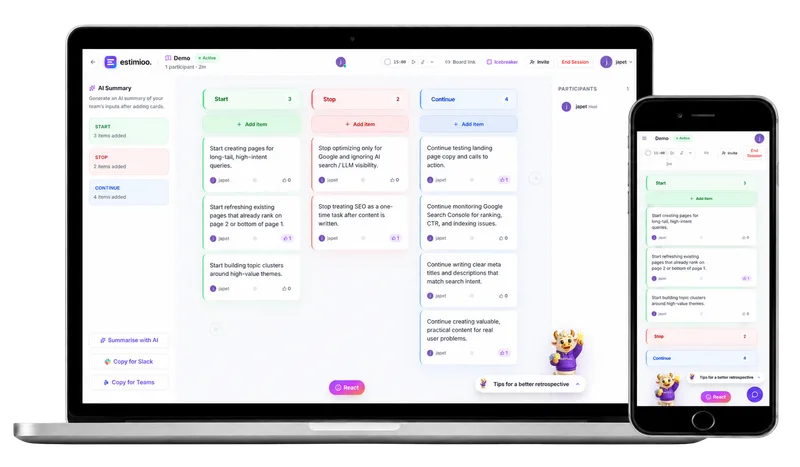
Estimioo is a lightweight, browser-based agile-ceremony tool that bundles AI-assisted planning poker, a template-driven sprint retrospective board and async daily standups into one shared workspace. The product's centre of gravity is estimation, but the retro module has grown since launch: the vendor now lists a library of retrospective formats (Start/Stop/Continue, Sailboat, Mad/Sad/Glad, 4Ls, Starfish, Sprint Timeline and more) rather than a single fixed board. It's still a reflection-and-summary tool, not a deep facilitation suite with dot voting, grouping and owned action items.

Best for: Small, distributed Scrum teams who mainly want fast, AI-assisted planning poker and async standups, and want a template-driven reflection board for retros rather than a full facilitation suite with voting, grouping and owned action items.

Estimioo retrospective board shown on desktop and mobile

How Estimioo describes itself

Estimioo pitches itself as a free, no-friction agile-ceremony tool for distributed Scrum teams — planning poker first, with retrospectives and async standups bundled into the same workspace.

"Free Planning Poker, Retrospectives & Standups for Scrum Teams."

The headline pitch is AI-assisted estimation: Claude reads a user story and suggests a point value with reasoning on complexity, risk and scope, and a Privacy Mode strips emails, URLs and company names before anything is sent. The voice is indie-maker and developer-friendly — no signup for guests, QR-code join, multiple estimation scales, and a flat per-workspace price rather than per-seat. Retrospectives are presented as one of three ceremonies, though the vendor now markets a growing library of retro formats (Sailboat, Starfish, 4Ls, Sprint Timeline and more) rather than the single reflection board it launched with.

Our take

Estimioo is a planning-poker tool first that happens to ship a retro board, and it's honest about that. The estimation side is the strong bit: multiple scales, hidden-until-reveal voting, Jira issue previews, and AI suggestions that flag outliers and track estimation accuracy across sprints. For a two-pizza team that mostly needs quick, async-friendly estimation at near-zero cost, it's a fair pick.

The retro side has grown. The vendor now lists a library of formats — Sailboat, Starfish, 4Ls, Mad/Sad/Glad, Sprint Timeline and more, each with its own template page — so it's no longer the single fixed board it launched with. That's a real step up. But it's still a reflection-and-summary board, not a facilitation engine: the product page now advertises anonymous voting, an action-items column and Claude-generated summaries of mood and themes, but I couldn't verify any of it hands-on, and there's still no evidence of dot voting, drag-and-drop grouping or a phase timer. The verified AI stays pointed at estimation, and there's no Slack/Teams, no SSO and no SOC 2. Note the site blocks automated fetches, so cell-level retro mechanics lean on vendor pages and search snippets rather than a hands-on read.

Buy it for planning poker; the retro board is a genuine bonus now, but not yet a reason to move a mature retro practice here.

Score breakdown

Ease of Use7.0
Retro Toolkit3.5
Value9.0
Fun Factor3.5
AI & Insights3.0
Integrations2.0
Open Platform0.5
Enterprise-grade1.5

Pros

  • + Genuinely cheap — flat $7/workspace/mo Team plan (not per-seat) and a usable free tier
  • + Fast, no-friction planning poker with multiple scales and hidden-until-reveal voting
  • + AI story-point suggestions and estimation-accuracy tracking, powered by Claude with zero data retention
  • + Guests join without signup via link or QR code — low overhead for distributed teams
  • + Three ceremonies (poker, retro, standup) in one shared workspace

Cons

  • Retro board is reflection-and-summary only — no dot voting, grouping, anonymity, phase timer or action items with owners and carry-over, even with the expanded template library
  • Verified AI is estimation-focused; the advertised Claude retro summaries (mood, themes, action items) couldn't be verified hands-on
  • No Slack/Teams, Confluence, GitHub, Linear or Azure DevOps integrations; Jira is a paste-URL preview for poker only
  • No SSO, SOC 2, audit logs or published data-residency — not built for enterprise procurement
  • Free sessions expire after 1 hour and cap at 5/month; no recurring retros or persistent retro history

Features

Retrospectives

Templates· Vendor now lists a library of retro formats (Start/Stop/Continue, Sailboat, Mad/Sad/Glad, 4Ls, Starfish, Sprint Timeline, etc.); couldn't re-verify count directly (site blocks automated fetches)Anonymous input· Advertised on the retro product page; couldn't verify hands-on (site blocks automated access)

Health checks

Mood / sentiment check· Mood check-ins on async standups, not on the retro board

Facilitation

Action items· Action Items column advertised on the retro product page; owners and carry-over unverifiedAsync mode· Async standups; retro board is real-time

Engagement

Mobile friendly· Browser-based; QR-code join for guestsPlanning poker· Core feature — Fibonacci, Modified Fibonacci, T-shirt, Powers of 2; hidden votes until reveal

AI

AI summary· Vendor advertises Claude-generated retro summaries (mood, recurring themes, prioritised actions); estimation AI is the verified coreAI sentiment / heatmaps· Vendor advertises Claude-based team-mood analysis of retro cards; unverified hands-onAI retro / health-check insights· AI surfaces estimation outliers and tracks estimation accuracy across sprints — not retro insights

Reporting

Export formats· CSV

Enterprise

Facilitator-only role· Host reveals votes in planning pokerGuest / observer roles· Guests join without signup (QR code / link)Meeting history· Sessions expire after 1 hour on Free

Integrations

Jira· Paste a Jira issue URL to auto-preview inside the planning-poker room (Team plan); no retro action-item push

Compare Estimioo against