Retrospective Tools
Kollabe logo
Retrospectives· Sydney, Australia· Founded 2023

Kollabe

Agile meetings made easy — retros, standups and planning poker

Overall score
5.6

Overview

Kollabe began life as a planning poker tool and has extended into retrospectives and standups — the estimation side remains the centre of gravity, with retros and standups added as adjacent rituals rather than the headline product. It bundles icebreakers, anonymous input, AI summaries and action-item sync-back to Jira, GitHub and Azure DevOps in a flat per-space workspace, and retro history exports in bulk to CSV or JSON. Recent additions include a Slack-based async standup flow, a public API and MCP server, and cross-ritual weekly reporting. Some retro mechanics the marketing asserts are not corroborated outside the vendor's own pages — verify the board before committing.

Best for: Small to mid-size agile teams that want retros, standups and planning poker in one clean tool — without per-seat pricing.

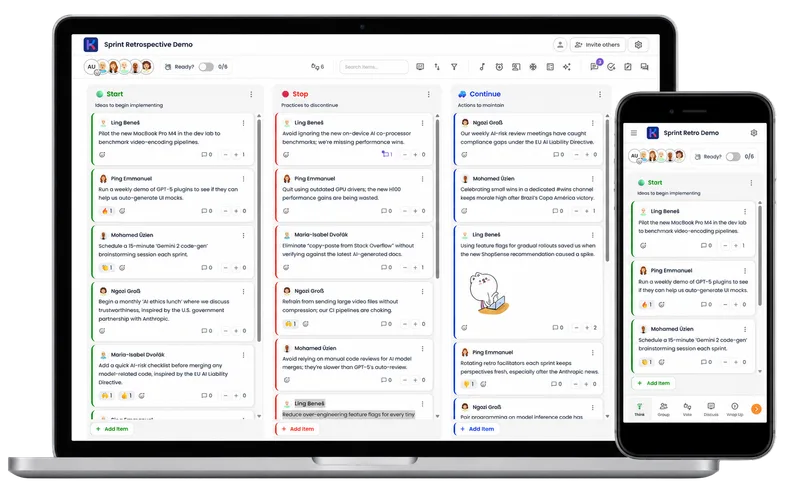
Kollabe retrospective board shown on desktop and mobile

How Kollabe describes itself

Kollabe pitches itself as "Agile Meetings, Made Easy" — one workspace for the four rituals most scrum teams actually run: planning poker, sprint retrospectives, daily standups and icebreakers. The wedge is friction and price.

"One flat rate for your whole team. No per-user fees, no surprises."

Everything leans on speed (no signup, instant join links) and flat per-space billing aimed squarely at per-seat incumbents. The homepage claims 40,000+ teams and 339,000 active users, and parades logos from Air Canada, Adobe, IBM, Mastercard and Atlassian — usage claims, not disclosed contracts. Sydney-based solo developer Matt Lewandowski is the whole brand: "every feature, every pixel, every line of code is crafted by me." Read the feature copy closely, though — the template count is quoted as 25+, 50+ and 1000+ on three different pages of the same site.

Our take

Kollabe's real strength is getting a retro started with zero friction, and that one isn't vendor spin — 31 verified third-party reviews average 4.8/5 with ease of use at roughly 5.0, and reviewers keep naming the no-signup join links. The retro-to-ticket loop holds up independently too: one reviewer reports that retro outcomes "actually become tickets that get worked on" through Jira and GitHub. Bulk export to CSV or JSON and one-click Confluence pages make the data genuinely portable, and $29/month per space with unlimited members is cheap for three teams of eight.

The gaps are real, and so is the need to check things yourself. Independent dot voting, drag-to-group and AI grouping all appear in marketing copy but in no changelog entry, and we couldn't corroborate them anywhere else. Slack is standup-only — no retro summaries or actions to a channel — and there's no Microsoft Teams. No health checks, no recurring schedules, no cross-team rollups, so spotting trends across six sprints isn't its game. No SOC 2, ISO 27001 or GDPR statement, and it's a one-person company.

Best fit: a small team that wants poker, retros and standups in one cheap tool — and will run a trial retro before committing.

Score breakdown

Ease of Use8.5
Retro Toolkit5.5
Value8.0
Fun Factor6.0
AI & Insights4.0
Integrations5.5
Open Platform5.5
Enterprise-grade2.0

Pros

  • + Flat per-space pricing — unlimited team members on Premium ($29/mo)
  • + Bundles retros, standups, planning poker and icebreakers in one tool
  • + No-signup join links lower friction for ad-hoc participants; ease of use rates ~5.0/5 across 31 verified third-party reviews
  • + Retro action items become real Jira and GitHub tickets — confirmed in independent user reviews, not just vendor copy
  • + Bulk export of retro history to CSV or JSON, plus one-click Confluence pages; public API and MCP server on Premium

Cons

  • Slack integration is standup-only (no retro summaries or actions to a channel); no Microsoft Teams
  • Solo-founder operation with no SOC 2, ISO 27001 or published GDPR posture; SSO/SAML and SLA sit behind Enterprise contact-sales
  • No health checks, team radars or longitudinal pulse — no way to track team trends across sprints
  • Several vendor-listed retro mechanics (independent dot voting, drag-to-group, AI grouping) are absent from the changelog and could not be corroborated
  • Free tier caps meetings/month with 7-day history and no data export; carrying actions between retros is paid-only

Features

Retrospectives

TemplatesCustom templatesAnonymous inputPrivate/public retros· password-protected roomsCustom process flow

Facilitation

Meeting timerAction itemsPresentation mode@mentionsCarry over open actions· Paid plans onlyAsync mode

Engagement

Mobile friendlyROTI feedback· Post-retro "was this worth your time?" poll; no ROTI trend trackingPollingIcebreakersGIFsPlanning poker

AI

AI template suggestionsAI summaryAI sentiment / heatmapsAI retro / health-check insights· Weekly cross-ritual "Team Insights" report; vendor-documented only

Reporting

Action kanban boardExport formats· Confluence, CSV, JSON

Enterprise

SSO / SAML· Enterprise plan onlyFacilitator-only roleGuest / observer rolesMeeting historyUptime SLA / dedicated support· Enterprise plan onlyPublic API· Premium and Enterprise plans only (REST, bearer token)MCP server· Premium plan only

Integrations

JiraLinear· Vendor lists Linear sync; not corroborated independentlyAzure DevOpsGitHubSlack· Standups only (async submissions + channel summaries) — not retrosConfluence· One-way export of a completed retro to a Confluence page

Compare Kollabe against