
Retrospectives· Quebec, Canada· Founded 2020
Neatro
Structured retros built around psychological safety
Overall score
5.5
Structured retros built around psychological safety
Best for: Scrum Masters who want a guided, safety-first facilitation flow with built-in team health tracking.
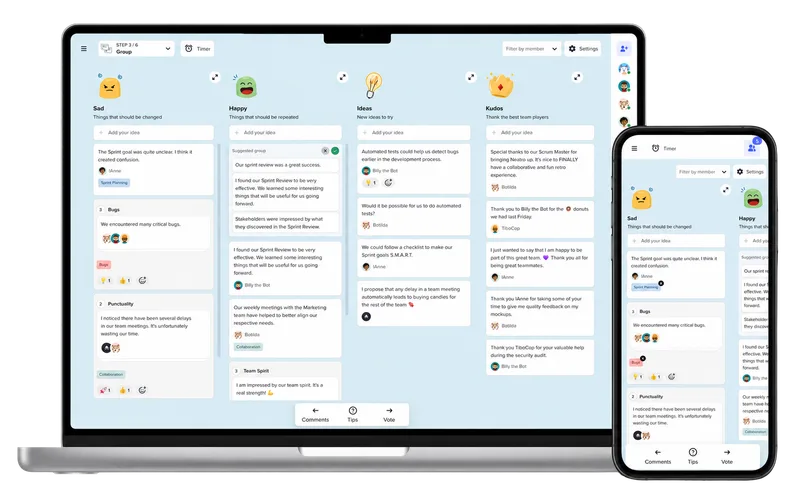
Neatro pitches itself as the place "where modern teams grow" — a calm, structured retrospective platform for distributed agile teams that puts psychological safety ahead of feature volume. The pitch rests on a four-step framework (Comments, Group, Vote, Action Plan), 70 ready-to-use templates plus a 450-strong community library called Neatroverse, optional anonymity and an automatic ROTI survey.
"With Neatro, foster psychological safety and cultivate continuous improvement."
Logos include Adobe, L'Oréal, Capgemini, Goodyear and Snyk against a claimed 80,000+ users. Team Radars and an action Kanban board are sold as the connective tissue between meetings, and the enterprise page leads with SAML, custom security reviews and a dedicated CSM rather than features. Notably, the vendor still markets no AI at all — the grouping assistant is documented only in the help centre.
Neatro takes facilitation craft more seriously than most. The four-step flow, optional anonymous commenting, a timer on any step and the automatic ROTI survey encode a real point of view about how a healthy retro runs, and Team Radar is a credible recurring health check with up to 10 custom dimensions, not a recycled template. Follow-through is the quiet strength: a Kanban board for actions, plus a prompt about last retro's unfinished items at the start of every session. The AI does exist, despite the silent marketing — Step 2 offers grouping suggestions the facilitator ticks or rejects one at a time, which is the right amount of automation for a room full of people. Comments carry GIFs and emoji reactions; async comment collection and scheduling work as documented.
The gaps are specific. Integrations are one-way action-item pushes to six trackers (Jira, Azure DevOps, GitHub, Asana, monday.com, iceScrum) — no Slack, no Teams, and neither exports nor integrations exist on the free plan. AI stops at grouping: no summaries, sentiment, extracted actions. Neatro holds no SOC 2 or ISO 27001 of its own (the security page points at Azure's), hosts only in Quebec City, and ships no SCIM, audit logs, public API or cross-team rollups.
Right for Scrum Masters who want retro quality over feature count; wrong for enterprises needing program-level reporting or a compliance attestation.