
Retrospectives· Pune, India· Founded 2010
IdeaBoardz
Free shared brainstorming boards
Overall score
3.1
Free shared brainstorming boards
Checked 2026-09-01: the site is up and in live use — the homepage counter read 36,656,330 ideas on 3,401,745 boards and rose by roughly 30 ideas within five minutes. We created a board, added an idea, voted on it and exported to PDF and Excel; all worked, and the TLS certificate was reissued on 2026-07-14. Development has stopped, though. The public source repository (github.com/dhavalsdoshi/Orter) has had no substantive commit since October 2020 and nothing at all since a Google Analytics tag change on 2026-04-01; the Terms still read "Last updated: 2020-04-01" and cite a privacy policy that returns a server error. The domain is registered through December 2027 and support is a Gmail address plus a Twitter handle; verify persistence before putting anything you care about on a board.
Best for: Throwaway retros and quick distributed brainstorms when nobody wants to sign up.
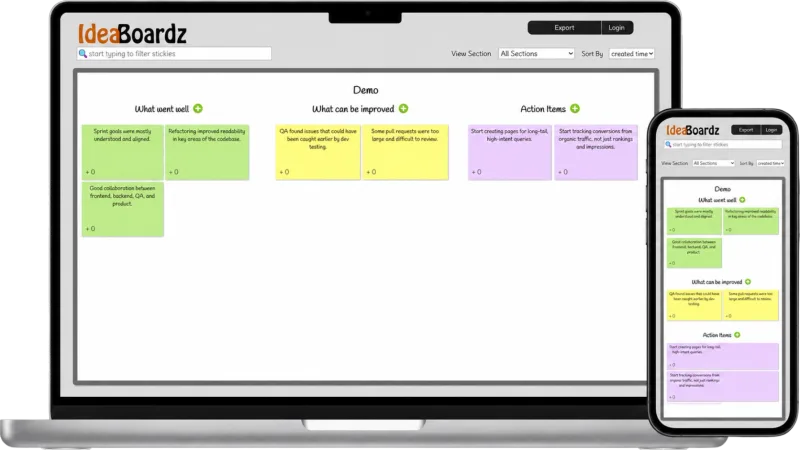
IdeaBoardz fits its whole pitch into one homepage line:
"Brainstorm, Retrospect, Collaborate."
The offer underneath is deliberately small. Pick a preset — Retrospective, Star Fish, Six Thinking Hats, Pros and Cons or Todos — or set your own one-to-ten columns, share the URL, and let teammates add ideas from wherever they are. There is no pricing page, no enterprise pitch, no roadmap and no blog; a homepage counter (36,656,330 ideas across 3,401,745 boards on 1 September 2026) does the persuading instead of feature marketing.
The implicit argument is that a shared link, a few columns, an upvote button and an export are enough for most distributed brainstorms — and that anything beyond that is somebody else's product.
IdeaBoardz is the sticky-note wall on a public wiki: no login, no setup, no cost. It does ship retro templates — five presets sit above the section-count options, and the Star Fish one lays out Keep Doing / Start Doing / Stop Doing / Less of / More of / Action Items in a click. Input is anonymous, anyone can upvote at any time, dragging one sticky onto another merges the pair and sums their votes, and PDF and Excel export both work. Boards poll every ten seconds, so a live session runs close enough to real time.
Everything else the agile stack needs is missing: no timer, no phases, no tracked action items with owners, no health checks, no Jira, no Slack, no SSO, no AI. Votes carry no per-person budget — we stacked five on one sticky from a single anonymous client — so one participant can tilt a board. The Terms cite a privacy policy that does not exist, and the URL is the only access control.
Fine for a workshop or a classroom. Not something to build a sprint cadence on.