
Retrospectives· Poland
RetroTool
Anonymous online retrospectives, no login required
Overall score
3.2
Anonymous online retrospectives, no login required
Re-checked 1 September 2026: the product works and is genuinely in use — the homepage retro counter moved from 993,316 on 3 August to 1,001,462, about 8,150 new retros in the month, and the Individual/Company plans are still purchasable at $10 and $20/team/mo through live Stripe prices. But development has stopped. The marketing site's static assets carry a Last-Modified date of 28 May 2024; the retro app still runs Meteor 2.9.0, a December 2022 release; the blog at blog.retrotool.io ends at 25 March 2022; the privacy policy and terms of use both still read 'Last update: 30th August 2020'; and the backend's own system settings are all expired 2023 entries. An 'enterprise_plan' feature flag exists in the app but is switched off. Parent agency u2i (about 60 people, Kraków and New York) still links RetroTool from its header and footer, so this is maintained hosting rather than an abandoned project.
Best for: Small or ad-hoc teams who want a free, no-signup retro board with private drafting, secret voting and a dozen standard templates — provided you're comfortable running on a tool whose last visible build is dated May 2024.
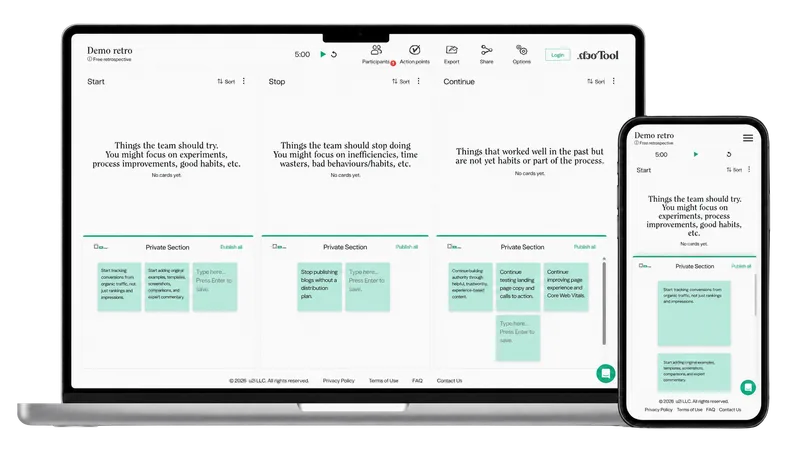
RetroTool sells friction removal to remote and hybrid teams: a retro board you can start without an account. The homepage counter crossed a million this year — it read 1,001,462 retros on 1 September 2026.
"You're always no more than 3 clicks away from having your retro ready."
Three templates plus a blank board are free and anonymous use is pitched as free forever. The paid tiers — Individual at $10/team/mo for up to 3 teams, Company at $20/team/mo for unlimited teams, both with a 90-day no-card trial and 15%+ off annually — aim at scrum masters and companies who want private invite-only retros, team action-point carryover and zero-knowledge encryption. The voice is engineer-plain: "no login or pesky 'go premium' popups", and a careers page that simply says "we are u2i, 60 problem-solvers".
RetroTool nails the ten-minute retro: per-column Private Sections so people draft unbiased, drag-to-group, secret-ballot dot voting with limits set per retro, column or card, a timer, and action points with an owner and a due date. Reading the shipped app turned up two things the marketing doesn't sell — a room-wide Single Column View the facilitator pushes to everyone (the code calls it presentation mode), and twelve live templates where the plan table still promises eleven.
Against what a program needs, the gaps are wide: no health checks, no recurring cadence, no async mode, no cross-team rollups, no AI, and no integration with Jira, Slack or Teams. Export is Markdown — plain or Confluence-flavoured — copied to the clipboard. Google sign-in is the only identity option; there is no SAML, SCIM, audit log or SOC 2.
A stable utility, not an evolving tool — and priced like one.